


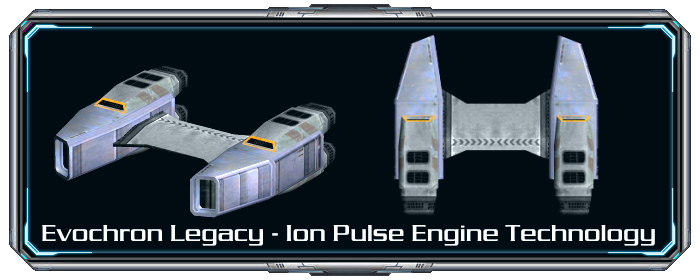
The spacecraft in Evochron use ion engines for maneuvering thrusters and main forward/reverse propulsion. Ion engines are fairly basic in their design and functional principles and have been part of space exploration since the 20th century. They are effectively electrical engines that create thrust by projecting ions in a given direction. Visually, they display a distinct blue color tone when active with a cone shaped projection of ions in the direction the thruster/engine is firing.
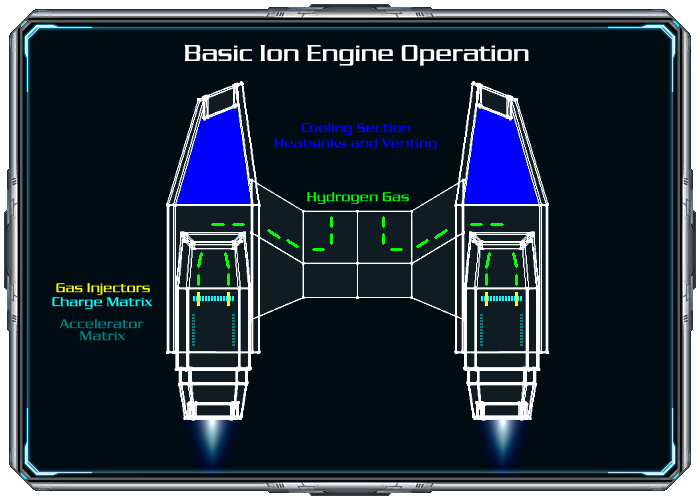
Ion engines in Evochron utilize a fuel source for generating high levels of electricity. Fuel (hydrogen gas) is stored in tanks on the spacecraft and is used for both the ion engines and some of the ship's related electrical systems. An atomic generator is also part of the electrical supply network for critical ship systems, but is unable to provide the propellant required for the thrusters and engines.
Early ion engines were severely limited by output restrictions, often 1/1000 the force of Earth's gravity or less. Later designs could supercharge power delivery and exhaust for a far greater output result, matching or even out performing chemical rockets of the time. Spacecraft in Evochron feature very powerful ion engines that also incorporate features like vectoring thrust and reverse thrust.
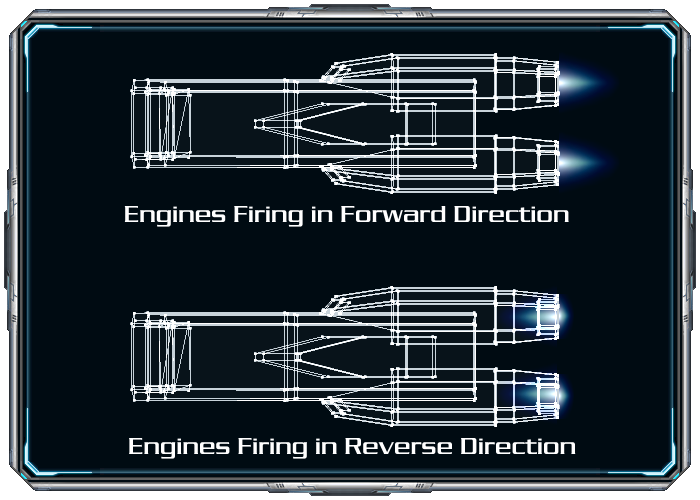
Current ion engine designs in Evochron use a pulse design, firing ions in a wave pattern that help keep engine internals, exhaust outlets, and overal ship heat signatures cooler. The ions are focused to a point at the back of the engine/thruster outlet and that point can then be directed, both in a vectored direction and in reverse. When fired forward, the cone of ions is projected out behind the exhaust outlet. When fired in reverse, the cone of ions is projected back toward the inside of the engine nacelle (there is plenty of space inside the engine nacelle for the cone of ions to fire inward). The reverse system is similar to how jet engines of the past could fire in reverse thrust, only no blast plates or hydraulic vents are required. Here is an image illustrating how this concept works:


 cool! I've got competition
 I've wanted to prepare something on the engine/propulsion system for some time, this is a start on that.

