

I loved playing DCS world because the electronics suite made me feel like I am actively engaged in electronic warfare. Changing the direction of the antennae to get better focus, locking on to radar contacts, jamming incoming radar signals, shooting off missiles before I can even see someone. It's exciting and adds a whole new dynamic to the cliche pew pew space combat.
Evorchron has been a blast so far. However, the ships' systems are lacking. I can amass crazy amounts of energy and bend space time but my radar can't see past 10 kilometers. I can magically scan through the shields and hulls of a vessel to detect individual cargo containers but I can't see farther than 10 km. Having great capabilities on one hand but harboring unrealistic weaknesses on the other is killing immersion.
The AN/APG-71 was placed in the F14D Tomcat in the 1980's and had a radar range of 370 km. The theoretical range was 740 km, but the antennae is too heavy for the bird. Radar ranges could get even longer than 800km, but the curvature of the earth could negate radar signal if the target was below the horizon.
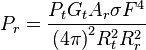
Radar equation:
https://upload.wikimedia.org/math/d/e/3 ... 8f8ae1.png
Updating radar naturally makes missiles relevant. Missiles should have uncanny ranges in space along with deadly precision. Though long range shots can be easily detected and avoided (jump away). Missiles, in my opinion, should be super dangerous. One would have to carry effective countermeasures, electronics suite, and pilot skill to avoid dying from missile attack. Missiles are essentially flying kamikaze murder robots.
With the ships having limited load out capability, a missiler could be an actual class one would opt components for. Balancing the game would make fast ships with stealth or missile jamming a nightmare for the long range archer. Though people that refuse to load up on missile defense will have to rely on savvy detection and maneuvering.
I should be able to radar lock and strike a target at ranges over 1000km. Though positively identifying and hitting that target are different stories altogether. I could be targeting a friendly or a comet for all I know.
How about we separate scanner ranges from radar ranges? Add more radar modes to simply identify objects at great range. The theoretical limits of radar in space is huge. I shouldn't be handicapped because of game balancing when playing a space sim.
If you don't want me scanning for crates, then add false contacts. Make radar more useless in nebulae. Add shorter range nebulae sonar mode. Sonar should theoretically work if the vacuum had enough gas content to act as a medium. Add so much detectable clutter that one would still have to get within scanning range to determine content. Even dust rings surrounding planets would show up on radar. I just want to see imagery on screen further away so I know if "something" is there.
The game has way to much empty to run around blindly wasting fuel. I'd actually mod these features in myself, but I have no hooks to tie into. The game is squirrely when scanning memory addresses too.
[Edited on 4-27-2016 by stuguy909]
Radar Detection
-
Nigel_Strange
- Captain

- Posts: 1254
- Joined: Fri Mar 25, 2005 5:51 am
Radar Detection
I think it would be interesting to experiment with these changes. However, the game has so far been balanced by committee in a sense, with a heavy emphasis on what characteristics appeal to the majority of players.
Some of us would like to see changes like this, while others are happy with things as they are. Drastic changes like this are the hardest ones to manage, as people would be in totally unfamiliar territory.
It would be interesting, though, to have a place where we could modify these characteristics and then try them out independently. There, though, you have no way to balance multiplayer and singleplayer gametypes.
Some of us would like to see changes like this, while others are happy with things as they are. Drastic changes like this are the hardest ones to manage, as people would be in totally unfamiliar territory.
It would be interesting, though, to have a place where we could modify these characteristics and then try them out independently. There, though, you have no way to balance multiplayer and singleplayer gametypes.
-
Vice

- Administrator

- Posts: 12227
- Joined: Fri Apr 25, 2003 1:38 am
Radar Detection
Interesting, I'll post some thoughts also.
For radar and tracking systems, this is where two elements apply in the game's design; gameplay and theoretical future projection. So anything that may be subjectively 'lacking' or 'unrealistic' as perceived by some would likely not be accounting for such objectives. The radar and tracking systems will only apply when they can retrieve full details about a target and are also subject to the inherent stealthiness of hull/frame coatings (what everything in the game is wrapped in) and ECM which inhibits scanning range to more local levels (done primarily to keep things close in range). As such, in open space, target tracking/scanning and radar detection is kept to 10K.
 The further out you push things, the more it tends to reduce the scope of 'fun' and 'excitement' for many people. You may enjoy electronic systems management and weapon firing-n-waiting at ultra long range, but that's not what this game is designed to achieve.
And indeed, it could be made possible to fire a missile at ultra-long range, but it would generally be pointless considering the effectiveness of countermeasures (emission stacking), potential evasion speed granted by long inbound flight time, and lack of intended vulnerability to the firing ship (also an intent of forcing closer ranges).
The future projection of this game is that reducing detection will become a core element of evasion and defensive tactics. Being able to mask a signal until close range is part of the spectrum of protection the game's theoretical future technology aims to simulate. Those masking systems can be further enhanced by additional stealth and cloaking technologies available in the game.
Lastly, have you used sensor stations/probes? Much of what you describe and indicate as interests can be facilitated by available longer range scanning devices.
As you may have noticed, the cargo scanning ranges are indeed already significantly shorter than the radar and target detail ranges.I can amass crazy amounts of energy and bend space time but my radar can't see past 10 kilometers. I can magically scan through the shields and hulls of a vessel to detect individual cargo containers but I can't see farther than 10 km. Having great capabilities on one hand but harboring unrealistic weaknesses on the other is killing immersion.
For radar and tracking systems, this is where two elements apply in the game's design; gameplay and theoretical future projection. So anything that may be subjectively 'lacking' or 'unrealistic' as perceived by some would likely not be accounting for such objectives. The radar and tracking systems will only apply when they can retrieve full details about a target and are also subject to the inherent stealthiness of hull/frame coatings (what everything in the game is wrapped in) and ECM which inhibits scanning range to more local levels (done primarily to keep things close in range). As such, in open space, target tracking/scanning and radar detection is kept to 10K.
'Should' is subjective and assumes that future radar, ECM, and stealth technology will only ever operate like it does today. And if you want to take 'realism' to a practical application, you'd be shooting laser beams at other ships hundreds of thousands or even millions of kilometers away... which wouldn't make for a very fun gameI should be able to radar lock and strike a target at ranges over 1000km. Though positively identifying and hitting that target are different stories altogether. I could be targeting a friendly or a comet for all I know.
The further out you push things, the more it tends to reduce the scope of 'fun' and 'excitement' for many people. You may enjoy electronic systems management and weapon firing-n-waiting at ultra long range, but that's not what this game is designed to achieve.And indeed, it could be made possible to fire a missile at ultra-long range, but it would generally be pointless considering the effectiveness of countermeasures (emission stacking), potential evasion speed granted by long inbound flight time, and lack of intended vulnerability to the firing ship (also an intent of forcing closer ranges).
The future projection of this game is that reducing detection will become a core element of evasion and defensive tactics. Being able to mask a signal until close range is part of the spectrum of protection the game's theoretical future technology aims to simulate. Those masking systems can be further enhanced by additional stealth and cloaking technologies available in the game.
Radar range is indeed already shortened when in nebula clouds, reduced by about 50%.Make radar more useless in nebulae.
That's subjective, so more input from others would be needed to gauge potential change. 'Should' and 'shouldn't' are too subjective. To apply such a subjective concept to the game, yes, you -should- be handicapped with range detection as that's what this game is designed to do in those elements for the reasons stated above.I shouldn't be handicapped because of game balancing when playing a space sim.
There are protections in place to prevent certain exploits/hacks (some passive that will break things later on if exploited, some direct that prevent immediate alteration) and also please keep forum rule 3 in mind here. That line of discussion should end here.The game has way to much empty to run around blindly wasting fuel. I'd actually mod these features in myself, but I have no hooks to tie into. The game is squirrely when scanning memory addresses too.
Lastly, have you used sensor stations/probes? Much of what you describe and indicate as interests can be facilitated by available longer range scanning devices.
-
matchbox2022
- Commander

- Posts: 609
- Joined: Fri Nov 13, 2015 3:21 pm
Radar Detection
As far as ultra realism goes, every game has a balance of gameplay, adventure, graphics, story and realism.
This game has still quite a bit of realism, I've gotten myself into a decent orbit around stars many a time.
I think there's another game in beta/alpha at the moment which is space based and a lot lot lot more like DCS with its involvement, I can't recall it right now, saw it on youtube. You literally need to be watching reaction temperatures and things like a hawk.
Different strokes different blokes.
Same reason why some people LOVE arcade style jet games and I'd rather use flight sim.
And who knows, maybe the radar is based on a different kind of EM or particle, like x-rays (Xdar?) it can clearly see through other ships and asteroids too
Just saying that'd explain the behaviour if that's all you want, high energy particles like that would be absolute crap for long range...but better for fine details up close (like cargo contents)
*I know that's a band-aid explanation*
[Edited on 4-26-2016 by matchbox2022]
This game has still quite a bit of realism, I've gotten myself into a decent orbit around stars many a time.
I think there's another game in beta/alpha at the moment which is space based and a lot lot lot more like DCS with its involvement, I can't recall it right now, saw it on youtube. You literally need to be watching reaction temperatures and things like a hawk.
Different strokes different blokes.
Same reason why some people LOVE arcade style jet games and I'd rather use flight sim.
And who knows, maybe the radar is based on a different kind of EM or particle, like x-rays (Xdar?) it can clearly see through other ships and asteroids too
Just saying that'd explain the behaviour if that's all you want, high energy particles like that would be absolute crap for long range...but better for fine details up close (like cargo contents)
*I know that's a band-aid explanation*
[Edited on 4-26-2016 by matchbox2022]
Do, or do not, there is no try.
- An Asian father.
- An Asian father.
-
Marvin

- Global Moderator

- Posts: 14373
- Joined: Wed Mar 04, 2009 5:47 am
- Location: Fallon-Reno
Radar Detection
 You'll probably need to change the name of the game to EWO (which was not the most popular crew position on a B-52).
[Edited on 4-27-2016 by Marvin]
-
stuguy909
- Ensign

- Posts: 12
- Joined: Sun Apr 24, 2016 10:10 am
Radar Detection
Yes I did. I actually like this short range like that. The Star Trek scanners should be nerfed.As you may have noticed, the cargo scanning ranges are indeed already significantly shorter than the radar and target detail ranges.
I think we are looking at two different things here. Radar isn't Friend of Foe, material scan, hull scan, shield scan, etc. Yes ECM can jam radar, but the funny thing about ECM is, you can detect the ECM...you light up like a Christmas tree, actually. You can just switch to BVR (thermals) to negate the ECM jam or lock on to the ECM jammer and kill him. ECM is good for running interference, like the AWACS lighting up a region so F-15's can drop bombs undetected.The radar and tracking systems will only apply when they can retrieve full details about a target and are also subject to the inherent stealthiness of hull/frame coatings (what everything in the game is wrapped in) and ECM which inhibits scanning range to more local levels (done primarily to keep things close in range). As such, in open space, target tracking/scanning and radar detection is kept to 10K.
Initially, at long range, we should be sending out electro-magnetic waves to determine if an object exists at great distances. So in this instance, we are switching to a long range radar mode and focusing the beam in a particular direction to see if a blip comes up at 500-1000km. Getting a hit, or series of hits on the scope will not tell you what exactly those blips are.
Let's say there are container crates hidden in rings around a planet. If I am within 800km of the planet, the 800-1000km section of my scope will be a giant blob mass. At around 600-700km on a broad scan, I also have a giant ring mass on my scope. Let's say I get within 300km of the ring, focus my beam angle and increase power (decrease radar range button). I am limiting the surface area of the scan and the scope will now better make out what is in the mass. Still no hits, get closer, decrease beam angle, increase power. This is essentially lowering the view range on the scope. Things become more and more pronounced when you are close.
Let's say within 100-200km, I have a few suspect scans I can jump to. I get in close and then have my 10k Star Trek scanners that identify everything in great detail. At long range, I get blobs, or a dot if it a lonely ship in the middle of nothing.
Let's say you change your Friend or Foe to 200 or 300km for radar identification. At long range I pick up what looks like a ship in the middle of nowhere, so I jump within 200-300km and the IFF (Identification Friend or Foe) says it is a friendly. Moving on. What if IFF comes back with hostile? What about no IFF registration at all? Curious...
Yes, they are not called long shots for nothingIndeed, it could be made possible to fire a missile at ultra-long range, but it would generally be pointless considering the effectiveness of countermeasures (emission stacking), potential evasion speed granted by long inbound flight time, and lack of intended vulnerability to the firing ship (also an intent of forcing closer ranges).
Generally speaking, when you get within 200km or 100km engagements, missile locks and launches force the other pilot to maneuver. If they are not skilled, they panic and fly into a missile or put themselves in a vulnerable position when the engagement turns close.The tactic here is that both pilots usually trade missile launches. A lock, fire, nose down and burn, pull up, lock, fire, nose down and burn. You do that over and over until the other guy is dead, or you are now at close quarters. If both parties are flying right at one another at 6000-7000m/s, only a few missile launches will be achieved anyways and a dogfight results.
Missiles are very dangerous at close range in R/L, and they often fly right past your target. Atmosphere slows missiles on earth, so the pilot just has to hit the deck. Space is different because the missile can use less energy to achieve consistent velocity. It can also miss, turn around, come back, and try again. If you also implement BVR / Stealth missiles....nobody will see it coming.
I saw thunder clouds in the last nebula I was in. That's a glitched out scope if there ever was one. It's electro-magnetic feedback. Clouds also distort and diffuse light, which causes inaccurate readings and limits range. I would say 100km is pushing it in Nebulae. Lightning should cause the scope to blip or static. Star Trek scanners should also be nerfed here, as you say.Radar range is indeed already shortened when in nebula clouds, reduced by about 50%.
I haven't found a build or deploy module. Stations don't seem to have internet telling me where to find or order parts I want. I saw an LP and it looks helpful. I like the idea of long range Star Trek scanners, but 100km radar should be on my ship by default.Lastly, have you used sensor stations/probes? Much of what you describe and indicate as interests can be facilitated by available longer range scanning devices.
[Edited on 4-27-2016 by stuguy909]
[Edited on 4-27-2016 by stuguy909]
[Edited on 4-27-2016 by stuguy909]
-
stuguy909
- Ensign
- Posts: 12
- Joined: Sun Apr 24, 2016 10:10 am
Radar Detection
I totally forgot BVR (thermal). The Russian's SU-27 can get about 20km for a BVR lock, and that's in atmosphere. Space is different because the system literally uses a thermal telescope. I also think a BVR scope should be added that detects heat signatures. 100km would be a good limitation. This again, is not radar, Star Trek scan, IFF, etc. This is just a heat dot that I could potentially fire a heat missile on if I had one.
Should a ship have a stealth drive, he would be invisible unless I had some super Star Trek scanner.
Should a ship have a stealth drive, he would be invisible unless I had some super Star Trek scanner.
-
Vice
- Administrator
- Posts: 12227
- Joined: Fri Apr 25, 2003 1:38 am
Radar Detection
That applies under the (big) assumption that ECM will work the same today as it will 800 years in the future. I'd imagine that future ECM would not be so 'Christmas tree' in giving away what it is or where it is. Good ECM would work as an effective stealth platform, not just overloading or confusing sensors, but masking from them. A variety of new and improved cloaking and ECM technologies will likely apply even over the course of the next few decades, let alone many hundreds of years in the future.Yes ECM can jam radar, but the funny thing is about ECM, you can detect the ECM...you light up like a Christmas tree, you just switch to BVR (thermals) or lock on to the ECM jammer. ECM is good for running interference, like the AWACS lighting up a region so F-15's can drop bombs undetected.
Now that has an appealing ring to it, particularly from my design background and interests in where I want to take the Evochron concept. More on that shortly. Anything over the current 10K limit for detailed information on a ship would probably not apply for the reasons mentioned earlier, but a longer range with vague direction information might be a possibility.Let's say you change your Friend or Foe to 200 or 300km for radar identification. At long range I pick up what looks like a ship in the middle of nowhere, so I jump within 200-300km and the IFF (Identification Friend or Foe) says it is a friendly. Moving on. What if IFF comes back with hostile? What about no IFF registration at all? Curious...
I've been pondering a nav subsystem interference cycle for close proximity lightning strikes. So for example, if the player has one within less than maybe 5K, the nav system is hit with a damage factor that varies based on proximity. A lightning blast at 5K might bring it down just a few percentage points, causing short term jittering on the radar display. A close blast at maybe 1K might bring it down 20-30 or more percentage points, causing a much longer and more dramatic effect.I saw thunder clouds in the last nebula I was in. That's a glitched out scope if there ever was one. It's electro-magnetic feedback. Clouds also distort and diffuse light, which causes inaccurate readings and limits range. I would say 100km is pushing it in Nebulae. Lightning should cause the scope to blip or static. Star Trek scanners should also be nerfed here, as you say.
On the subject of long range, no IFF radar... One change I have been willing to consider after all these years would be an extended radar range mode. That is, a radar range mode that would allow the generic detection of ships at ranges beyond the detail limit (10K). This would keep containers, beacons, shipwrecks, etc at their current reduced limits of detection, requiring careful search patterns and gauge/visual watching... but still allow for much greater range for ship detection. When set to this new 'long range' mode (maybe 'LR' displayed on the radar screen), the radar might display such contacts as yellow blips, providing only a general direction indicator and no friend-or-foe threat detection, no ID/name, no directional velocity, no shield data, no hull damage status, etc. Just a directional yellow blip to indicate a ship is out there, but no identifying information until the contact is brought within detail scanning range. It would work in both 2D and 3D radar modes. Would like to hear from players on what they'd think, particularly if there might be any drawbacks or negative effects that could apply if the range of such a system were bumped out to even as far as double (20K) the detail range.
[Edited on 4-27-2016 by Vice]
-
stuguy909
- Ensign
- Posts: 12
- Joined: Sun Apr 24, 2016 10:10 am
Radar Detection
Radar detection is also a whole different beast.
Most modern air ships have radar detection warnings. This includes friendly radars. AAA, (ground)Short range SAM, (ground)medium range SAM, (ground)long range SAM, AWACS(ECM), and fighter radars are all detectable and categorized on modern fighter computers. The direction where the threats are coming from are also indicated by the computer on the air frame.
In the Russia air frames, to keep things simple, only the highest priority alerts the pilot. Priorities from least to greatest are:
AAA
Short range
Medium range
Long range
AWACS
Fighter
Lock
Missile
When a radar locks on to you, there is an entity that is actively trying to get a missile or reading lock on your air frame. Thus, this alert trumps everything save an actual missile launch.
Missile launches have the most annoying beep and the air frame has both a HUD and a radar detection computer indicator light.
The radar detection computer is literally a picture of a fighter plane with lights at varying degree points on the ship. They also have range lights and radar type lights. There is plenty of room in the cockpit for a radar detection computer system
Radar detection is important for mapping out air defenses, patrols, and of course, saving your butt.
Edit: I also think this is referred to as a radar threat indicator or radar warning indicator.
[Edited on 4-27-2016 by stuguy909]
Most modern air ships have radar detection warnings. This includes friendly radars. AAA, (ground)Short range SAM, (ground)medium range SAM, (ground)long range SAM, AWACS(ECM), and fighter radars are all detectable and categorized on modern fighter computers. The direction where the threats are coming from are also indicated by the computer on the air frame.
In the Russia air frames, to keep things simple, only the highest priority alerts the pilot. Priorities from least to greatest are:
AAA
Short range
Medium range
Long range
AWACS
Fighter
Lock
Missile
When a radar locks on to you, there is an entity that is actively trying to get a missile or reading lock on your air frame. Thus, this alert trumps everything save an actual missile launch.
Missile launches have the most annoying beep and the air frame has both a HUD and a radar detection computer indicator light.
The radar detection computer is literally a picture of a fighter plane with lights at varying degree points on the ship. They also have range lights and radar type lights. There is plenty of room in the cockpit for a radar detection computer system
Radar detection is important for mapping out air defenses, patrols, and of course, saving your butt.
Edit: I also think this is referred to as a radar threat indicator or radar warning indicator.
[Edited on 4-27-2016 by stuguy909]
-
Marvin
- Global Moderator
- Posts: 14373
- Joined: Wed Mar 04, 2009 5:47 am
- Location: Fallon-Reno
Radar Detection
Most RHAW, etc. operate similar to the missile warning in the EL HUD, which gives an audio signal (not as cool as Eddie but close enough) and azimuth. It then automatically (if you have the installed equipment aboard your ship) does its best to defeat the missile.
-
stuguy909
- Ensign
- Posts: 12
- Joined: Sun Apr 24, 2016 10:10 am
Radar Detection
Asside from some sort of fancy subparticle that is smaller than photons manipulating one's mechanical engineering somehow...I could only speculate how an advanced human or alien species would interfere with electronics by ionizing the air with insane amounts of electrons or teleporting in nano-bots.That applies under the (big) assumption that ECM will work the same today as it will 800 years in the future. I'd imagine that future ECM would not be so 'Christmas tree' in giving away what it is or where it is.
Generating enough power to control space time yields marvels we could only dream of. Propulsion drives are completely useless if you can just slide through the fabric of space and time. I do not think territorial conflict is sensible for a species that can harness the power of many suns and go anywhere they please, but I love SciFi so I'll role with it.
ECM is essentially a near lethal dosage of electro-magnetic radiation bombarding electro-magnetic sensors. This form of light can also be pulsed out in certain patterns that are known to trick a primitive radar system into showing more contacts that what is really there. The typical ECM is bombardment in order to disguise other radar contacts.Good ECM would work as an effective stealth platform, not just overloading or confusing sensors, but masking from them. A variety of new and improved cloaking and ECM technologies will likely apply even over the course of the next few decades, let alone many hundreds of years in the future.
This wave of energy coming from an ECM unit overloads the target collector and disallows it from focusing on weaker signals. That radar is so buzzed with energy that it can't tell you what is real and what is fake.
A good ECM in a stealth ship is a waste because the stealth ship becomes unstealth by emitting crap tons of a light frequency. Using ECM in an F-22 should only be used if they somehow detected you or get a radar lock. Or if there are lots of primitive air frames in the area that can get visual contact and the ECM is known to trick their radar and lure them away.
Though a standard radar cannot discern where exactly the ECM contact is, there are advanced radars and systems that can follow the light source to the ECM. Driving into a quiet area with ECM turned on lets everyone know someone is out there and is generally a bad idea. If someone is on to you, ECM is a good idea.
AWACS and ECM runners are very useful in the capacity, however. That's why the USAF employs the AWACS and have fighter variants with ECM suites. It distracts the enemy while non-stealth fighters and bombers move in for the kill.
Their ECM, simply put, gives your radar threat detector an overdose of electrons making it difficult to read anything else. That's what is meant by radar suppression. It is no different than suppressive gunfire. A good airman friend of mine got cancer from his tenure on AWACS missions. EMF can cause health problems.
I am glad you are at least open to the thought. I believe that's what makes space sims what they are. Awesome. Not only the flight and freedom, but the immersion in cool detectors and jammers that are a value add to everything else.Now that has an appealing ring to it, particularly from my design background and interests in where I want to take the Evochron concept. More on that shortly. Anything over the current 10K limit for detailed information on a ship would probably not apply for the reasons mentioned earlier, but a longer range with vague direction information might be a possibility.
Breakers are pretty damn good in air planes. Lighting is plasma, and full of volts that can fry electronics good. However, in fighters especially, there are breakers and backup breakers along with proper grounding and insulation of the electronics and backup systems / aux power. Direct hits are common. I was in a Boeng that got hit and plummeted 10000 feet, but the engines came back on and we pulled out of it.I've been pondering a nav subsystem interference cycle for close proximity lightning strikes. So for example, if the player has one within less than maybe 5K, the nav system is hit with a damage factor that varies based on proximity. A lightning blast at 5K might bring it down just a few percentage points, causing short term jittering on the radar display. A close blast at maybe 1K might bring it down 20-30 or more percentage points, causing a much longer and more dramatic effect.
Add shields and I think you have a recipe for stopping plasma dead in it's tracks. I do like the jittering / static on the display idea. The EMF in the nebula would certainly cause conflict in the electromagnetic light spectrum.
Certainly a step in the right direction. 20k ship identification would certainly be better than 10k. I'm actually getting the feeling you have a legitimate worry that people will more quickly find the little secrets tucked away with larger scanning ranges. Limiting our eyes forces us to drive more and work harder to find stuff. There is a simple remedy to that...more clutter and more interference. Add more debris in the quadrant. Useless debris, comets, rocks etc. The oo, what's this on my 200km range finder, jump, damnit, useless junk again, debris.On the subject of long range, no IFF radar... One change I have been willing to consider after all these years would be an extended radar range mode. That is, a radar range mode that would allow the generic detection of ships at ranges beyond the detail limit (10K). This would keep containers, beacons, shipwrecks, etc at their current reduced limits of detection, requiring careful search patterns and gauge/visual watching... but still allow for much greater range for ship detection. When set to this new 'long range' mode (maybe 'LR' displayed on the radar screen), the radar might display such contacts as yellow blips, providing only a general direction indicator and no friend-or-foe threat detection, no ID/name, no directional velocity, no shield data, no hull damage status, etc. Just a directional yellow blip to indicate a ship is out there, but no identifying information until the contact is brought within detail scanning range. It would work in both 2D and 3D radar modes. Would like to hear from players on what they'd think, particularly if there might be any drawbacks or negative effects that could apply if the range of such a system were bumped out to even as far as double (20K) the detail range.
I know from online sources that many secrets are tucked away in caves, nebulae, and space rings. But what about random trash formations that number in the millions? Stuff that isn't registered on the sector map? Most of the game is empty, and you should know, space has a lot of garbage floating in it, especially around gravitational bodies. By significantly increasing clutter on the scope, you could actually mess with people and waste their time more, even with long range scanners

What I want to see is a 1000km max range, but I have to control the antennae on my HUD to scan. You take a cone formula and put the tiny point on a coin that is on a robotic swivel in your nose cone. You can swivel that coin about 30 degrees in every direction in front of the air frame. The HUD would have a small circle indicating where my antennae is pointing, and that's what shows up in the scope. Only that cone of vision.
That cone can also alter the angle in which it is emitted. Radars can be focused, but incrementally reduce range when they do so. You are already doing this with 2,4,6,8,and10k ranges, though formations of contacts do not exist in 10k range....here is a solution for that:
You need more radar contact types, or tags. You then need more sprites for those said tags to go on the radar. Planets, asteroids, rings, stations, ships, derelicts, comets, junk, boxes, trash, cluster forms, and lightning. You then draw those contacts relative to their presence in the cone at that current power level / mode. You must have a series of boolean that illustrates the various tags at certain sprite sizes depending on your mode and power. You can actually draw a planet's edge on a deep scan by accounting for the sprite's center in relation to your cone zone.
If a planet core (x,y,z) is just outside of the radar cone, then make sure you account for the radius of the largest sprite outside of the cone zone. This way your large contacts will partially render on the edge of the radar scope.
If you increase power and decrease angle (lower X factor), the sprite types change. You don't want to render a planet or large body in a 2k scope, perhaps not even a planet in a 10. Medium sized contacts would be larger in the short ranged scopes, or not there at all. The closer the scope, the more defined. Like rings don't show up on a 10k anymore, and asteroids don't appear in 2 or 4. It's up to you on how to figure out which item sizes would trick the higher powered scopes and take away definition from small finds.
All in all, you can significantly stall people by enhancing the scanning minigame.
-
matchbox2022
- Commander
- Posts: 609
- Joined: Fri Nov 13, 2015 3:21 pm
Radar Detection
Yeah I think EL does the proximity alarm well.
ECM and jamming shouldn't be thought of as the same thing. Jamming is definitely spilling the beans on someone being there, ECM is a vague term for a whole slew of options, electronic warfare might be a better term.
For example, newer ECM typically uses the onboard radar to selectively jam and selectively phase match incoming radar in an attempt to send a return back that is phase cancelled.
All that radar detection stuff has a lot more to do with an airframes shape (angles versus typical wavelengths used), coatings and frequency.
Extending the range would be a nice touch in EL, it really should be beyond visual range anyways for detection and locking onto at the least "some sort of" object with no identification.
PS. Radar does not give out electrons, nor is it ionizing radiation.
However high levels of it would induce "thermal" heating...same as a microwave oven (more or less)
[Edited on 4-27-2016 by matchbox2022]
ECM and jamming shouldn't be thought of as the same thing. Jamming is definitely spilling the beans on someone being there, ECM is a vague term for a whole slew of options, electronic warfare might be a better term.
For example, newer ECM typically uses the onboard radar to selectively jam and selectively phase match incoming radar in an attempt to send a return back that is phase cancelled.
All that radar detection stuff has a lot more to do with an airframes shape (angles versus typical wavelengths used), coatings and frequency.
Extending the range would be a nice touch in EL, it really should be beyond visual range anyways for detection and locking onto at the least "some sort of" object with no identification.
PS. Radar does not give out electrons, nor is it ionizing radiation.
However high levels of it would induce "thermal" heating...same as a microwave oven (more or less)
[Edited on 4-27-2016 by matchbox2022]
Do, or do not, there is no try.
- An Asian father.
- An Asian father.
-
Marvin
- Global Moderator
- Posts: 14373
- Joined: Wed Mar 04, 2009 5:47 am
- Location: Fallon-Reno
Radar Detection
This has all been very entertaining but it really doesn't get around the fact that the principle of radar is "energy out - energy back." And the only way to get energy back is for the energy out to bounce off an object with high reflectivity. Like today's stealth aircraft, objects in the far distant future will most likely be made of materials which absorb energy. Ships, in particular, will be even less susceptible to radar because of their shielding. Logically, a ship with a class 10 shield should be invisible to radar except at extremely close range. Possibly, the shield would absorb all types of energy, including visible light. Ergo, the only thing you would be able to detect visually would be the black silhouette of a ship (leastwise, until you fire on the silhouette and disturb the shield).
-
stuguy909
- Ensign
- Posts: 12
- Joined: Sun Apr 24, 2016 10:10 am
Radar Detection
It's light and not radioactive. It is referred to as Electro Magnetic radiation sometimes. A radar can cook you if you hang out too close for too long.From post: 187890, Topic: tid=12658, author=matchbox2022 wrote:Yeah I think EL does the proximity alarm well.
ECM and jamming shouldn't be thought of as the same thing. Jamming is definitely spilling the beans on someone being there, ECM is a vague term for a whole slew of options, electronic warfare might be a better term.
For example, newer ECM typically uses the onboard radar to selectively jam and selectively phase match incoming radar in an attempt to send a return back that is phase cancelled.
All that radar detection stuff has a lot more to do with an airframes shape (angles versus typical wavelengths used), coatings and frequency.
Extending the range would be a nice touch in EL, it really should be beyond visual range anyways for detection and locking onto at the least "some sort of" object with no identification.
PS. Radar does not give out electrons, nor is it ionizing radiation.
However high levels of it would induce "thermal" heating...same as a microwave oven (more or less)
[Edited on 4-27-2016 by matchbox2022]
edit: Electrons surging through iron, copper, silver, gold, etc, is what gives off the radio waves. It is a scientific reaction. Power cords in your room? There is radio signal in there.
[Edited on 4-27-2016 by stuguy909]
-
stuguy909
- Ensign
- Posts: 12
- Joined: Sun Apr 24, 2016 10:10 am
Radar Detection
Correct. Though navigators and star charters would still find radar useful in mapping systems and imaging planetary surfaces. Radar is also useful for finding unknown objects at long ranges. Though less useful for tracking advanced warships of the future. It is also useful for navigating asteroid fields at high speed, as one could plot better courses using less fuel, though the asteroid fields in EL are not so menacing.From post: 187891, Topic: tid=12658, author=Marvin wrote:This has all been very entertaining but it really doesn't get around the fact that the principle of radar is "energy out - energy back." And the only way to get energy back is for the energy out to bounce off an object with high reflectivity. Like today's stealth aircraft, objects in the far distant future will most likely be made of materials which absorb energy. Ships, in particular, will be even less susceptible to radar because of their shielding. Logically, a ship with a class 10 shield should be invisible to radar except at extremely close range. Possibly, the shield would absorb all types of energy, including visible light. Ergo, the only thing you would be able to detect visually would be the black silhouette of a ship (leastwise, until you fire on the silhouette and disturb the shield).
Radar would find hidden metal treasures or abandoned ships. Though like I mentioned in an earlier post, you can trick people by adding more useless debris in the game.
-
stuguy909
- Ensign
- Posts: 12
- Joined: Sun Apr 24, 2016 10:10 am
Radar Detection
Of course, everyone has their own style they enjoy. The boys at Starwraith need paychecks too, and the best way to get that is sell software licenses. So catering to the fan base is very important in that sense.As far as ultra realism goes, every game has a balance of gameplay, adventure, graphics, story and realism.
This game has still quite a bit of realism, I've gotten myself into a decent orbit around stars many a time.
That's why adding significant mod support is a good answer, as it appeals to creative fans and draws in more people because they can install a particular style of game that fits them. It is important to have a strong core game, which I believe EL has. Though balancing between two types of play styles is a matter of opinion. Hence mods.Same reason why some people LOVE arcade style jet games and I'd rather use flight sim.
I agree. I actually wouldn't change the short range Star Trek scanners. I think they work fine for getting significant details on targets when they are within visual range. Beyond visual, I would like to see something to get rough ideas on objects that are in a short jumping distance from your current position.And who knows, maybe the radar is based on a different kind of EM or particle, like x-rays (Xdar?) it can clearly see through other ships and asteroids too
Just saying that'd explain the behaviour if that's all you want, high energy particles like that would be absolute crap for long range...but better for fine details up close (like cargo contents)
*I know that's a band-aid explanation*
-
Marvin
- Global Moderator
- Posts: 14373
- Joined: Wed Mar 04, 2009 5:47 am
- Location: Fallon-Reno
Radar Detection
Actually, you already do: on your HUD, radar and navigation map. The only objects not displayed are those which, because of their ability to absorb radar energy, can't be detected at the greater ranges. The only logical method of detecting them would be via passive energy-detecting equipment ... and that would only be possible if the energy output was fairly large. But, from an engineering standpoint, future equipment might either require less energy or have shielding to avoid emitting most of the energy generated. Except, of course, the radar itself. If shipboard targeting systems used a particular frequency band not associated with any other type of radar ... that might be the answer. Assuming your detection equipment was sensitive enough and the radar emissions of your target extended far enough.From post: 187895, Topic: tid=12658, author=stuguy909 wrote:Beyond visual, I would like to see something to get rough ideas on objects that are in a short jumping distance from your current position.
-
stuguy909
- Ensign
- Posts: 12
- Joined: Sun Apr 24, 2016 10:10 am
Radar Detection
By generic sprites on the nav map representing randomly placed objects throughout its sector you mean? That seems more place holder than feature to me. Asteroids are invisible on radar and map when I get close.Actually, you already do: on your HUD, radar and navigation map. The only objects not displayed are those which, because of their ability to absorb radar energy, can't be detected at the greater ranges.
The asteroid circles flying all around my cockpit is annoying, so I turn it off and have no other way of detecting them other than visual.
Passive by absorbing particles you mean? We have that now. There are literally hundreds of sensors of varying types. We can go on all day about absorbing vibrations, the light spectrum, and other smaller than proton particles. The F-22 has sensors that we don't even know exist yet.The only logical method of detecting them would be via passive energy-detecting equipment ... and that would only be possible if the energy output was fairly large. But, from an engineering standpoint, future equipment might either require less energy or have shielding to avoid emitting most of the energy generated. Except, of course, the radar itself. If shipboard targeting systems used a particular frequency band not associated with any other type of radar ... that might be the answer. Assuming your detection equipment was sensitive enough and the radar emissions of your target extended far enough.
This doesn't negate the fact that there are thousands of ways to detect uncharted boundaries in space, especially the generic ones in EL that are never listed on maps. A telescope perhaps?
I personally think there is room for improvement.
-
Marvin
- Global Moderator
- Posts: 14373
- Joined: Wed Mar 04, 2009 5:47 am
- Location: Fallon-Reno
Radar Detection
You have a telescope. It's your quadrant map. And, if the asteroid circles annoy you, well ... shutting them off is kind of like shutting off the missile warning (which you might also find annoying) or the engine overheat light in your car or the smoke alarm on the ceiling or your house (which, when cooking, can be the most annoying of all).
-
matchbox2022
- Commander
- Posts: 609
- Joined: Fri Nov 13, 2015 3:21 pm
Radar Detection
Well, having ships be detectable but not identifiable from a gameplay perspective would be nice to extend beyond seeing it, even 30k. Could be limited to big ships, asteroids, ships, and not things that are small like cargo boxes or beacons.
Just a bit of a thought on it gameplay wise.
and yes you're right, an EM wave (radio) can induce a current just as a moving charge can induce an EM wave (radio).
Apologies, I thought you were talking about radar "emitting electrons" and those reflect off an airframe....
Although radar will heat you up, it still isn't ionizing radiation however. Typically UV<->X-Ray will do that, or high energy particles from alpha or beta decay. If it were it'd eat up crazy amounts of power to get even decent ranges.
That said, when you see lightning, it should be screwing up things like your nav system, getting hit would be something I'd love to see in game and make it feel as if there's actual "risk" entering some nebulae.
Just a bit of a thought on it gameplay wise.
and yes you're right, an EM wave (radio) can induce a current just as a moving charge can induce an EM wave (radio).
Apologies, I thought you were talking about radar "emitting electrons" and those reflect off an airframe....
Although radar will heat you up, it still isn't ionizing radiation however. Typically UV<->X-Ray will do that, or high energy particles from alpha or beta decay. If it were it'd eat up crazy amounts of power to get even decent ranges.
That said, when you see lightning, it should be screwing up things like your nav system, getting hit would be something I'd love to see in game and make it feel as if there's actual "risk" entering some nebulae.
Do, or do not, there is no try.
- An Asian father.
- An Asian father.
-
Swede
- Ensign
- Posts: 20
- Joined: Tue Feb 16, 2016 5:31 pm
Radar Detection
Well if the dust from this discussion has settled, I would like to say that I think a low detail high range radar would be a great addition to the game.
-
XenonSurf
- Lieutenant

- Posts: 221
- Joined: Mon Jan 28, 2008 3:01 pm
Radar Detection
Seeing further than 10km: You can deploy a Sensor Station to quickly locate enemies and objects. The range will be huge, but the contacts will depend on your position relative to the Sensor, so you need to jump to different locations in the sector to get reliable infos and a 'global' view. Once the sensor is in place, it's dynamic. The only thing: don't leave the sector or it vanishes.
What I would like is a Angle-Off indicator telling me what the heading of an enemy ship is relative to my heading, so I can plan BFM maneuvres. The icons on the radar should at least roughly denote what the heading of a ship is, this would be really useful in combat IMO.
But maybe this is already somewhere in the hud or MFDs ?
XenonS
[Edited on 4-28-2016 by XenonSurf]
What I would like is a Angle-Off indicator telling me what the heading of an enemy ship is relative to my heading, so I can plan BFM maneuvres. The icons on the radar should at least roughly denote what the heading of a ship is, this would be really useful in combat IMO.
But maybe this is already somewhere in the hud or MFDs ?
XenonS
[Edited on 4-28-2016 by XenonSurf]
-
Marvin
- Global Moderator
- Posts: 14373
- Joined: Wed Mar 04, 2009 5:47 am
- Location: Fallon-Reno
Radar Detection
I think the little triangular shaped thingy accompanying your targeted ship acts as an angle-off indicator.
-
XenonSurf
- Lieutenant
- Posts: 221
- Joined: Mon Jan 28, 2008 3:01 pm
Radar Detection
(Edited my post above)...From post: 187924, Topic: tid=12658, author=Marvin wrote:I think the little triangular shaped thingy accompanying your targeted ship acts as an angle-off indicator.
Thanks Marvin, I will look for it next time, I often use the 'Inertial' attack method to fly-by an enemy, this heading info is quite useful.
XenonS
[Edited on 4-28-2016 by XenonSurf]
-
Marvin
- Global Moderator
- Posts: 14373
- Joined: Wed Mar 04, 2009 5:47 am
- Location: Fallon-Reno
Radar Detection
I'm not sure ... I rarely pay attention to most of the information on the HUD. But I quickly checked the Cockpit Viewer and thought, "Oh yeah, there's that thingy."