

I have been doing some tests accelerating and decelerating in various configurations (IDS on or off, differences between facing different directions while keeping speed the same etc) to quantify fuel use and the extra decelerating ability IDS gives you. When I heard people talk about using IDS to assist in quickly changing direction I assumed they meant they found it easier than using inertial. It was not until a few days ago I realised that turning IDS on allows you to reduce your lateral and vertical velocity faster than is possible in inertial mode if you press down the appropriate strafe key.
I was going to wait until I had finished collecting data and then present it in a table. But, I have found a circumstance where the acceleration curve is behaving incoherently. In my tests I have been going to 6k and then slowing down. When I tested having 6k lateral velocity and then turning on IDS (with set speed equal to 0) I slowed to a stop as expected. It took about 2 minutes to come to a stop.
However, if I have a speed of 6k and I turn so that it is about equally shared between two directions (I have tested lateral right +forward and lateral right plus vertical up) so the speed in each direction is 4240ish then turn on IDS I do not decelerate as fast. After over 5 minutes my velocity had not changed appreciably even though I had burned through more than 100 fuel. I have done this a couple of times so anyone should be able to reproduce the same behaviour.
I am on 1.182 and I did the test in a evoch-e but I expect people will get the same results regardless of frame. The velocity it starts becoming an issue at probably depends on your frame..
In other tests I found you accelerate far slower with lateral and vertical inertials both pressed down than by just using one of them. After two minutes thrusting with both lateral and vertical from rest I got up to about 3200 in each direction for a total speed of about 4500. If everything was working sensibly I would have achieved a velocity of over 6000 since the total thrust I am applying is greater (specifically the vector sum of the thrust in the two directions is 2^0.5 times greater than the thrust in one direction).
I have encountered this issue during normal play, sometimes I have been puzzled by why my acceleration seems to be far less than expected at high speeds. I now know that it is because of the direction I was facing relative to my velocity.
[Edited on 17-11-2010 by Aures]
Acceleration curve direction dependency
-
Aures
- Lieutenant

- Posts: 307
- Joined: Sun Sep 19, 2010 1:32 am
- Location: Sydney, Australia
Acceleration curve direction dependency
Speed is life
-
Marvin

- Global Moderator

- Posts: 14373
- Joined: Wed Mar 04, 2009 5:47 am
- Location: Fallon-Reno
Acceleration curve direction dependency
 Sheldon couldn't have said it better himself....
Edit: exchanged a default emote for one more appropriate.
[Edited on 11-17-2010 by Marvin]
-
Vice

- Administrator

- Posts: 12227
- Joined: Fri Apr 25, 2003 1:38 am
Acceleration curve direction dependency
Your main engine is signficantly more powerful than your lateral thrusters. That becomes more apparent the faster you go (the more momentum you build up). And at off angles, where the thrusters are split, can both reduce the engine involvement and diagonal effectiveness of the thrusters. If you want to slow down from a high speed faster, turn to an angle where your engine does most of the work (either forward or reverse) directly. If you -really- want to slow down quickly from high speed, flip around 180 degrees so you are drifting backwards and fire the afterburners (or firing them in reverse should also be just about as effective).
-
Aures
- Lieutenant
- Posts: 307
- Joined: Sun Sep 19, 2010 1:32 am
- Location: Sydney, Australia
Acceleration curve direction dependency
The issue is not with the main engines. In both cases I am only using lateral and vertical inertials (the forward/reverse inertials would also work, it is only the afterburner which is more powerful). The two inertial engines are at right angles to each other. They both produce thrust, therefore if you fire both of them at once the total thrust is greater by the law of vector addition. Therefore you should accelerate faster than when using only one inertial engine. Accelerating slower makes absolutely no sense. It has nothing to do with engines of different power levels. The lateral and vertical inertial thrusters are as powerful as each other. It is not possible to put two vectors at right angles and have the vector addition be less than either vector. The following image is for distances but the principle is exactly the same:
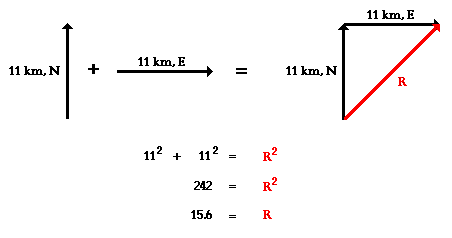
I don't want to slow down faster, I want the thrust system to be more or less Netwonian as advertised. The behaviour I described violates the basic principles of geometry and rocketry. Why is the acceleration curve determined by the direction your ship is facing relative to your velocity vector? Surely the Pythagorean theorem should hold in the Evochron universe?
How is it possible that it takes two minutes to reach a certain velocity from rest using one engine (black line) and then not to be able to slow down to rest by using two engines (red line) in less than two minutes? I can understand this as a bug or oversight but I can't believe it is desired and intentional functionality.
Thanks for you response, the reverse afterburner is indeed exactly as effective as the afterburner in my tests. But the issue is not the afterburner vs the inertials. The inertial thrusters are less effective at an angle as you say (just reverse the above diagram so red is the direct thrust from a single engine and black is the thrust output at a 45 degree angle to the engine) but when you add two of them at once their combined thrust is greater than the direct output from a single engine, not less. Part of the thrust from each engine gets cancelled out by the other one, the rest produces a combined thrust that is 1.41 times as great as a single engine can produce.
I don't want to slow down faster, I want the thrust system to be more or less Netwonian as advertised. The behaviour I described violates the basic principles of geometry and rocketry. Why is the acceleration curve determined by the direction your ship is facing relative to your velocity vector? Surely the Pythagorean theorem should hold in the Evochron universe?
How is it possible that it takes two minutes to reach a certain velocity from rest using one engine (black line) and then not to be able to slow down to rest by using two engines (red line) in less than two minutes? I can understand this as a bug or oversight but I can't believe it is desired and intentional functionality.
Thanks for you response, the reverse afterburner is indeed exactly as effective as the afterburner in my tests. But the issue is not the afterburner vs the inertials. The inertial thrusters are less effective at an angle as you say (just reverse the above diagram so red is the direct thrust from a single engine and black is the thrust output at a 45 degree angle to the engine) but when you add two of them at once their combined thrust is greater than the direct output from a single engine, not less. Part of the thrust from each engine gets cancelled out by the other one, the rest produces a combined thrust that is 1.41 times as great as a single engine can produce.
Speed is life
-
Vice
- Administrator
- Posts: 12227
- Joined: Fri Apr 25, 2003 1:38 am
Acceleration curve direction dependency
Yeah, a product of improper offset calculations. Although exact 1:1 timing/thrust may be tricky to implement, I'll see how close I can get with adjustments, changes, different calculations, etc.
Edit: also one other point, two thrusters firing will attempt to use the same amount of fuel as one (the computer's fuel optimizing attempts) depending on the ship's orientation for a consistent acceleration/deceleration regardless of angle. You can actually measure this by fuel consumption. So any acceleration/deceleration would, in theory, be 1:1 whether you are at 0 degrees or 45 degrees due to that concept. Obviously, it's not working that way at the moment (and the variation increases with increased velocity), so I'll be working toward correcting that.
[Edited on 11-16-2010 by Vice]
Edit: also one other point, two thrusters firing will attempt to use the same amount of fuel as one (the computer's fuel optimizing attempts) depending on the ship's orientation for a consistent acceleration/deceleration regardless of angle. You can actually measure this by fuel consumption. So any acceleration/deceleration would, in theory, be 1:1 whether you are at 0 degrees or 45 degrees due to that concept. Obviously, it's not working that way at the moment (and the variation increases with increased velocity), so I'll be working toward correcting that.
[Edited on 11-16-2010 by Vice]
-
Aures
- Lieutenant
- Posts: 307
- Joined: Sun Sep 19, 2010 1:32 am
- Location: Sydney, Australia
Acceleration curve direction dependency
Awesome, thanks Vice.
I am in the middle of running a test demonstrating how bad the issue is. Here are steps I have followed:
1) Load game;
2) Engage inertial mode;
3) hold down right lateral inertial thruster until speed is 6000 (takes just under 2 minutes in my evoch-e and consumes 19 fuel);
4) Turn right 45 degrees so heading is now 45 degrees xz angle and 0 degrees y angle. Velocity is then 4236 forward, 4239 right;
5) Engage IDS.
It is now over 15 minutes later and my velocity is still 4236 forward, 4239 right. I know the thrusters are firing because my fuel is now under 600 (it was 1180 at the end of step 3). I am only using IDS to avoid holding down the buttons, it makes no difference to the experiment ie if I omit step 4 it takes the same length of time for my velocity to hit 0 as as it did to get from 0 to 6000.
EDIT:
I can see the logic from a gameplay perspective for not giving an acceleration advantage to holding down multiple inertials at once. I think we are all familiar with strafe running from FPS games to increase movement speed. It is also easy to justify by saying the inertial thruster system is limited by fuel consumption so if you engage multiple ones at once it has to share the same amount of fuel between more engines.
I assume the same is supposed to hold true if you engage all 3 inertial thruster axes at once. I would imagine the afterburner has a separate fuel supply mechanism so engaging an inertial plus afterburner gives slightly better acceleration (so is a version of strafe running) but I can also see justification for applying the same idea as the inertials so you always have the same acceleration (for a given speed) when using the afterburner regardless of whether an inertial thruster (or two) is engaged or not.
[Edited on 16-11-2010 by Aures]
I am in the middle of running a test demonstrating how bad the issue is. Here are steps I have followed:
1) Load game;
2) Engage inertial mode;
3) hold down right lateral inertial thruster until speed is 6000 (takes just under 2 minutes in my evoch-e and consumes 19 fuel);
4) Turn right 45 degrees so heading is now 45 degrees xz angle and 0 degrees y angle. Velocity is then 4236 forward, 4239 right;
5) Engage IDS.
It is now over 15 minutes later and my velocity is still 4236 forward, 4239 right. I know the thrusters are firing because my fuel is now under 600 (it was 1180 at the end of step 3). I am only using IDS to avoid holding down the buttons, it makes no difference to the experiment ie if I omit step 4 it takes the same length of time for my velocity to hit 0 as as it did to get from 0 to 6000.
EDIT:
I can see the logic from a gameplay perspective for not giving an acceleration advantage to holding down multiple inertials at once. I think we are all familiar with strafe running from FPS games to increase movement speed. It is also easy to justify by saying the inertial thruster system is limited by fuel consumption so if you engage multiple ones at once it has to share the same amount of fuel between more engines.
I assume the same is supposed to hold true if you engage all 3 inertial thruster axes at once. I would imagine the afterburner has a separate fuel supply mechanism so engaging an inertial plus afterburner gives slightly better acceleration (so is a version of strafe running) but I can also see justification for applying the same idea as the inertials so you always have the same acceleration (for a given speed) when using the afterburner regardless of whether an inertial thruster (or two) is engaged or not.
[Edited on 16-11-2010 by Aures]
Speed is life
-
Yob
- Ensign

- Posts: 8
- Joined: Tue Oct 19, 2010 8:06 pm
- Location: Alabama
Acceleration curve direction dependency
Impressive, You made my head hurt, and my left eye bleed.... 
-
deathMinder
- Ensign
- Posts: 33
- Joined: Thu Oct 07, 2010 7:25 pm
Acceleration curve direction dependency
This is interesting to me, since I pretty much exclusively use inertial mode and control my strafing with a joystick. If I'm reading this correctly, since I'm almost never only using one thruster (unless I happen to be in a dead zone on the x or y axis of the stick) then it kinda puts me at a disadvantage compared to using single keys?
If that's the case then definitely thanks for looking into this Vice. And thanks to you Aures for your testing! I feel like this might explain why my butt kinda slides out from under me as I make my hard turns in combat.
If that's the case then definitely thanks for looking into this Vice. And thanks to you Aures for your testing! I feel like this might explain why my butt kinda slides out from under me as I make my hard turns in combat.
Starwolves Clan
Callsign: [SW] dM
Callsign: [SW] dM
-
Aures
- Lieutenant
- Posts: 307
- Joined: Sun Sep 19, 2010 1:32 am
- Location: Sydney, Australia
Acceleration curve direction dependency
Nice stuff with 1.184, as always your response to feedback is most impressive.
The new system seems much better in general. However, my testing has revealed some things that will probably need further tweaking, there are some inconsistencies that were not present before. I have only done preliminary tests, I will let you know once I have confirmed what is going on.
At this stage I would like to focus on using lateral/vertical thrusters to decrease lateral/vertical velocity while IDS is turned on. You could significantly increase your deceleration by holding down the appropriate inertial prior to 1.184. It basically halved the time it took to come to a complete stop, making it only slightly less effective than turning to face the direction of motion and using reverse afterburner to stop (or turning directly away and using afterburner). The changes in 1.184 have greatly increased the effectiveness of the first procedure while slightly decreasing the effectiveness of the second. In 1.182 using afterburner to stop (from 6k in evoch-e) took about 51 seconds while using IDS + inertial took about 59 seconds (as per my previous post, using just IDS or inertials took about 118 seconds). Now in 1.184 using afterburner takes about 56 seconds while IDS + inertial takes only 31 seconds. Using inertials by themselves is one of those things that has some discrepancy, I will need to test further to see exactly what is going on.
So contrary to your first post in this thread the most effective way to slow down is now to turn 90 degrees relative to your direction of motion, engage IDS and hold down the appropriate inertial. I assume this is not desired behaviour. I understand why holding down the inertials while in IDS is more effective than just letting IDS slow you down (provided the direction you engage the inertials in reduces your lateral/vertical velocity) or using inertials in inertial mode, it makes IDS more effective and stops those inertials from being useless in IDS. However, the system prior to 1.184 made more sense in this regard. IDS+inertial doubled the thrust of inertials or IDS by themselves but was slightly less effective than using afterburner.
Taking the logic you use for engaging multiple inertials at once (ie total fuel use and thrust is the same whether 1,2 or 3 inertials are engaged at once) it is possible to come up with a logical progression for how much different actions accelerate you. Assuming using the afterburner in inertial mode plus one or more inertial thrusters gives you better acceleration than just using the afterburner (required because otherwise engaging IDS and holding down the appropriate inertial would make the afterburner almost totally ineffective) the various acceleration levels in increasing order would be:
any combination of inertials/IDS engaged with no inertials or afterburner
IDS engaged with inertials held down in a direction that decreases your lateral or vertical velocity
afterburner
afterburner + any combination of lateral and vertical inertials in inertial mode/afterburner in IDS regardless if lateral or vertical velocity/afterburner in IDS + inertials that decrease your lateral or vertical velocity
Let me know if that requires further explanation. Basically the idea is that afterburner + inertials needs to have better acceleration than just afterburner to make IDS work sensibly. The extra lateral/vertical acceleration you can get in IDS would be taken away from the afterburner thrust the same way holding down multiple inertials in inertial mode does not increase your acceleration. Afaik the system may already work more or less like this or it might have the following less sensible progression (or some variation of it):
any combination of inertials/IDS engaged with no inertials or afterburner
IDS engaged with inertials held down in a direction that decreases your lateral or vertical velocity
afterburner/afterburner + any combination of lateral and vertical inertials in inertial mode
afterburner in IDS regardless if lateral or vertical velocity
afterburner in IDS + inertials that decrease your lateral or vertical velocity
When I first learned about the extra kick you can give inertials in IDS I regarded it as a fudge required for gameplay reasons. Now it seems like a perfectly logical and consistent part of the engine system provided it is handled in the right way.
The new system seems much better in general. However, my testing has revealed some things that will probably need further tweaking, there are some inconsistencies that were not present before. I have only done preliminary tests, I will let you know once I have confirmed what is going on.
At this stage I would like to focus on using lateral/vertical thrusters to decrease lateral/vertical velocity while IDS is turned on. You could significantly increase your deceleration by holding down the appropriate inertial prior to 1.184. It basically halved the time it took to come to a complete stop, making it only slightly less effective than turning to face the direction of motion and using reverse afterburner to stop (or turning directly away and using afterburner). The changes in 1.184 have greatly increased the effectiveness of the first procedure while slightly decreasing the effectiveness of the second. In 1.182 using afterburner to stop (from 6k in evoch-e) took about 51 seconds while using IDS + inertial took about 59 seconds (as per my previous post, using just IDS or inertials took about 118 seconds). Now in 1.184 using afterburner takes about 56 seconds while IDS + inertial takes only 31 seconds. Using inertials by themselves is one of those things that has some discrepancy, I will need to test further to see exactly what is going on.
So contrary to your first post in this thread the most effective way to slow down is now to turn 90 degrees relative to your direction of motion, engage IDS and hold down the appropriate inertial. I assume this is not desired behaviour. I understand why holding down the inertials while in IDS is more effective than just letting IDS slow you down (provided the direction you engage the inertials in reduces your lateral/vertical velocity) or using inertials in inertial mode, it makes IDS more effective and stops those inertials from being useless in IDS. However, the system prior to 1.184 made more sense in this regard. IDS+inertial doubled the thrust of inertials or IDS by themselves but was slightly less effective than using afterburner.
Taking the logic you use for engaging multiple inertials at once (ie total fuel use and thrust is the same whether 1,2 or 3 inertials are engaged at once) it is possible to come up with a logical progression for how much different actions accelerate you. Assuming using the afterburner in inertial mode plus one or more inertial thrusters gives you better acceleration than just using the afterburner (required because otherwise engaging IDS and holding down the appropriate inertial would make the afterburner almost totally ineffective) the various acceleration levels in increasing order would be:
any combination of inertials/IDS engaged with no inertials or afterburner
IDS engaged with inertials held down in a direction that decreases your lateral or vertical velocity
afterburner
afterburner + any combination of lateral and vertical inertials in inertial mode/afterburner in IDS regardless if lateral or vertical velocity/afterburner in IDS + inertials that decrease your lateral or vertical velocity
Let me know if that requires further explanation. Basically the idea is that afterburner + inertials needs to have better acceleration than just afterburner to make IDS work sensibly. The extra lateral/vertical acceleration you can get in IDS would be taken away from the afterburner thrust the same way holding down multiple inertials in inertial mode does not increase your acceleration. Afaik the system may already work more or less like this or it might have the following less sensible progression (or some variation of it):
any combination of inertials/IDS engaged with no inertials or afterburner
IDS engaged with inertials held down in a direction that decreases your lateral or vertical velocity
afterburner/afterburner + any combination of lateral and vertical inertials in inertial mode
afterburner in IDS regardless if lateral or vertical velocity
afterburner in IDS + inertials that decrease your lateral or vertical velocity
When I first learned about the extra kick you can give inertials in IDS I regarded it as a fudge required for gameplay reasons. Now it seems like a perfectly logical and consistent part of the engine system provided it is handled in the right way.
Speed is life
-
Marvin
- Global Moderator
- Posts: 14373
- Joined: Wed Mar 04, 2009 5:47 am
- Location: Fallon-Reno
-
Aures
- Lieutenant
- Posts: 307
- Joined: Sun Sep 19, 2010 1:32 am
- Location: Sydney, Australia
Acceleration curve direction dependency
I was the same way, I never used IDS and advised others not to. Before I understood the extra kick IDS can give your lateral/vertical decelaration ability I scoffed at those who suggested using IDS for manoeuvring. The problem was not limited to inertial mode however, IDS was just as badly affected by the incorrect offsets.Originally posted by deathMinder
This is interesting to me, since I pretty much exclusively use inertial mode and control my strafing with a joystick. If I'm reading this correctly, since I'm almost never only using one thruster (unless I happen to be in a dead zone on the x or y axis of the stick) then it kinda puts me at a disadvantage compared to using single keys?
If that's the case then definitely thanks for looking into this Vice. And thanks to you Aures for your testing! I feel like this might explain why my butt kinda slides out from under me as I make my hard turns in combat.
Using IDS will still give you an advantage in killing off lateral and vertical velocity and that is unlikely to be changed. It is required for gameplay reasons and provided it is correctly implemented as an ability to automatically shunt main engine power to the lateral and vertical inertials it makes perfect sense from a technical standpoint as well.
EDIT:Thanks Marvin, very constructive of you.
[Edited on 17-11-2010 by Aures]
Speed is life
-
Pyroka
- Lieutenant Jr. Grade

- Posts: 51
- Joined: Thu Oct 28, 2010 7:31 pm
- Location: Somwhere between the edges of the Universe
Acceleration curve direction dependency
I agree with Marvin, seems like you may have a tad more time on your hands than is healthy. Then again, I'm the one who spends hours each day thinking about the physics of Fulcrum technology, so I guess I don't have any room to talk.
Space Billiards is the best game ever!
Dino-Killer, Vonari homeworld.
Dino-Killer, Vonari homeworld.
-
Aures
- Lieutenant
- Posts: 307
- Joined: Sun Sep 19, 2010 1:32 am
- Location: Sydney, Australia
Acceleration curve direction dependency
I do have a tad more time than is healthy, mainly because I am not healthy so I have the time. EM is doing a good job from keeping me going stir crazy while I am sick (as it does for a lot of people around here who have health issues).
But, as you can see from the changes Vice made the stuff I am bringing up involves real issues (rather than the aesthetic issues like the tangent I went on about jump speeds in my acceleration curves thread). There are still real issues introduced by the changes in 1.184, just compare these two quotes:
But, as you can see from the changes Vice made the stuff I am bringing up involves real issues (rather than the aesthetic issues like the tangent I went on about jump speeds in my acceleration curves thread). There are still real issues introduced by the changes in 1.184, just compare these two quotes:
Originally posted by Vice
Your main engine is signficantly more powerful than your lateral thrusters. That becomes more apparent the faster you go (the more momentum you build up). And at off angles, where the thrusters are split, can both reduce the engine involvement and diagonal effectiveness of the thrusters. If you want to slow down from a high speed faster, turn to an angle where your engine does most of the work (either forward or reverse) directly. If you -really- want to slow down quickly from high speed, flip around 180 degrees so you are drifting backwards and fire the afterburners (or firing them in reverse should also be just about as effective).
Originally posted by Aures
In 1.182 using afterburner to stop (from 6k in evoch-e) took about 51 seconds while using IDS + inertial took about 59 seconds (as per my previous post, using just IDS or inertials took about 118 seconds). Now in 1.184 using afterburner takes about 56 seconds while IDS + inertial takes only 31 seconds. Using inertials by themselves is one of those things that has some discrepancy, I will need to test further to see exactly what is going on.
So contrary to your first post in this thread the most effective way to slow down is now to turn 90 degrees relative to your direction of motion, engage IDS and hold down the appropriate inertial. I assume this is not desired behaviour.
Speed is life
-
Vice
- Administrator
- Posts: 12227
- Joined: Fri Apr 25, 2003 1:38 am
Acceleration curve direction dependency
Given your description, it would seem the only viable solution would be to prevent the double-increase lateral/vertical thruster with IDS condition, thus preserving the existing performance and behaviors of all other controls.
-
Aures
- Lieutenant
- Posts: 307
- Joined: Sun Sep 19, 2010 1:32 am
- Location: Sydney, Australia
Acceleration curve direction dependency
Sure, no skin off my nose. I kind of dislike ever having a reason to use IDS. I thought it was something you put in deliberately to make IDS more effective at turning and that you would want to keep it. Taking it out might rankle a few people who are more used to using it though.
EDIT: The double inertial deceleration in IDS was mostly making up for the improper offsets. Now that the offsets have been fixed the performance in inertial mode is comparable to IDS in circumstances where the double deceleration was very useful (at least in the limited testing I have done in 1.184 so far). That means that removing it shouldn't make too much difference to people who are used to using it in older versions.
[Edited on 17-11-2010 by Aures]
EDIT: The double inertial deceleration in IDS was mostly making up for the improper offsets. Now that the offsets have been fixed the performance in inertial mode is comparable to IDS in circumstances where the double deceleration was very useful (at least in the limited testing I have done in 1.184 so far). That means that removing it shouldn't make too much difference to people who are used to using it in older versions.
[Edited on 17-11-2010 by Aures]
Speed is life
-
Marvin
- Global Moderator
- Posts: 14373
- Joined: Wed Mar 04, 2009 5:47 am
- Location: Fallon-Reno
Acceleration curve direction dependency
Thanks Marvin, very constructive of you.

-
Koranis
- Lieutenant
- Posts: 106
- Joined: Fri Jun 19, 2009 2:41 pm
Acceleration curve direction dependency
Heh, it's great to see this game practically dissected 
I can only mention a few of such games in the entire industry... for the others the process ends after 5 minutes.
I can only mention a few of such games in the entire industry... for the others the process ends after 5 minutes.